Tuesday, March 22, 2011

Don't Forget About Latin America

President Obama has caught some serious flack for his visit to South America this week, mostly by those saying that he should be focused on the current disasters in Libya and Japan. While these tragedies obviously deserve Obama's attention, it's ludicrous to say he should have cancelled his long-awaited trip South. Rick Sanchez wrote a fantastic piece for The Huffington Post on the necessity of the trip; explaining it's importance, he says:

Going to Latin America isn't a party, it doesn't interfere with your [Obama's] duties, and it's not about job creation. It's about far more than that. Going to Latin America is the work of the president, important and essential work, and it's in our national and strategic interest.
It's about treating Latin America as equal partners, something you, President Obama, promised at the Summit of the Americas in 2009. It's about cultivating a stronger relationship with this part of the world and sending a message to Latin America, as well as Latino-Americans here at home, about their importance in the global economy as well as national and international politics.
He touches on what America has not been doing for the past, oh, let's say six decades--the North American reluctance to deal with their neighbors down below. Hopefully this trip will be exactly what Sanchez calls it, an opportunity to reforge relations with our natural geographical allies and diplomatic partners. Of course, the trip is just getting underway so who knows. But even though there's a lot going on outside of our hemisphere, we'll be watching.

Guys, he looked REALLY hard. 
And in other Latin American news, Hugo Chavez says capitalism wiped out life on Mars.

Monday, March 21, 2011

Wyclef Jean: A Self-Fulfilling Prophecy...Sort Of

About a week ago I talked about Wyclef Jean as an example of political activism run rampant in rap music, specifically mentioning his track "If I Was President." A sampling of the lyrics if you please:
If I was President, I'd get elected on Friday,
Assassinated on Saturday, buried on Sunday.  
Well, I suppose life imitates art.

Last Saturday night, Wyclef Jean was shot during Haiti's presidential elections. No, he was not elected president the day before and he did not die; the shot was actually to the hand, and whether or not it was actually a bullet is still sketchy. But still, a little eerie.
 

Saturday, March 12, 2011

Tell Me What You Want From Me


Following in the footsteps of music executive Steve Stoute, I am writing a letter to the National Academy of Recording Arts and Sciences regarding the 2011 Grammys. The letter is seven words, short and sweet:
To Whom It May Concern:
What more do you want from Eminem?
Last month, Eminem was nominated for 10 Grammy awards for Recovery, his album chronicling the struggles of a man just recently emerged from the cycle of domestic violence and drug abuse that fueled his violent lyrical career for a decade, and in every category that did not explicitly contain “rap” in the title he lost. This was not the first slight to Eminem, whose 2000 Album of the Year loss to the reemergence of Steely Dan is often cited as one of the most heinous Grammy snubs ever; the Eminem case and the omission of rapper Guru from the obituary reel are the most recent indicators of an out-of-touch academy that has passed on the works of rap powerhouses Jay-Z, Kanye West, Public Enemy, and Dr. Dre in any category not limited to their genre. The pattern begs the question: Does NARSA, and by extension the community of the musical elite, accept rap music as valid? They don’t, but they should. The Grammy Academy needs to stop turning its back on the most creative genre of our generation and accept that rap is an enduring art form that will long outlast the critics who consider it all to be the misogynistic or sadistic dregs of jazz and soul; rap will continue as an important part of cultural expression facilitating social consciousness, political activism, and poetry.

Rap has many merits that qualify it as a valuable form of cultural expression, from the innovative uses of sampling and remixing to the creation of new beats, but most fascinating is its often-ignored lyrical depth. Yes, there is a significant percentage of rap music that is, to put it nicely, shallow; critics are quick to jump on the lower content of the genre: easy women, fancy cars, recreational drug use, and violence (gang, domestic, police—the list is extensive). They turn a blind eye to the diverse lyricism of rap and choose to focus on themes that, in a truly demented way, are just perversions of our purest national obsession: The American Dream. To say that these are definitive of a category as broad as rap, or its even broader parent hip-hop, is recklessly metonymic.

Since its inception, rap has had a decidedly socio-economic bent. Whether under- or overtones in an overall track, the themes of poverty, crime, and racial conflict are represented throughout the last three decades of rhymes. The ways in which these themes are addressed has evolved as rappers have taken a different position in society, but they always reflect the unfortunate realities of the haves and the have-nots. In 1982, Grandmaster Flash and the Furious Five released “The Message,” commenting on the issues of debt, education, prostitution, inflation, and unemployment in just seven minutes; The Notorious B.I.G. spun a similar tale with a happier ending in 1994’s rags-to-riches track “Juicy,” and Jay-Z picked up where that left off chronicling the perils of fame in 2001’s “Heart of the City.” And even off of Eminem’s Recovery there is the “Love The Way You Lie,” a wrenching duet with survivor Rihanna that exposed the inner-workings of an abusive relationship in a more real way than a psychology textbook ever could. Social awareness is a huge cornerstone of rap content. Admittedly, not every track is socially conscious; songs like “No Hands” and “Look At Me Now,” while catchy, are more about boasting about sexual prowess than acknowledging the dangers of promiscuity. But this is exactly the point, that rap is a diverse genre that churns out a significant amount of culturally relevant and artistically important work.

Rap is also infused with politics, making it a viable artistic expression of a moment or movement. Artists such as Common involved themselves in social and political campaigns, while others are figureheads for political movements like “the ghetto’s populist prince” Tupac. Again, not every work of politically inclined rap is a winner; for every brilliant call to vote like Wyclef Jean’s “If I Were President,” there is a misguided effort like Young Jeezy’s “My President.” But the message persists in making rap part of our political history, another primary source in our analysis of the century. Internationally, rap has really taken off as a mechanism for idea diffusion and political change. Lyricist El Général spit the anthem for protesters in his native Tunisia, while secretive rapper Ibn Thabit did the same for Libya; less incendiary sociopolitical leanings also pop up in the music of UK rapper Plan B and French-Senegalese rapper MC Solaar.

But even if rap was as hollow and meaningless as some have claimed, there is no denying the sheer beauty of (some of) it. As I’ve qualified everything thus far, this is not a blanket statement for all rap; some lyrics are vapid, ill conceived, and just grammatically incorrect. But others are modern-day poetry made for mass consumption and more readily consumed by our attention-challenged generation. Single line pop-culture quips by popular artists such as Kanye West (“Mayonnaise colored Benz, I push Miracle Whips”) are matched by indie rappers like Childish Gambino (“I move real quick like Nestle/Let me make it clear for a second like Pepsi”), elaborate metaphors are spun (such as the life of hip hop in Common’s “Used to Love H.E.R.”), and creative imagery is used to avoid censors. It is poetry to a beat, and the artistry behind the best rappers’ lyrics overrule objections based on their bedfellows’ lesser ones. It is through this lyricism, so poetic and socially relevant, that rap captures important moments in time through cultural expression that needs to be recognized for what it truly is—good music.

Monday, February 28, 2011

And For All That...


After all the writing I just did on the importance and prevalence of American media, the film that dominated the Oscars was made by a British director, written by a British playwright, and acted by a largely British (the one exception being an Australian) cast. Oh well.

That being said, if you haven't seen The King's Speech, you should. It truly was fantastic. Also, congratulations to all the winners from last night and to James Franco for further convincing us all that Pineapple Express was semi-biographical.

Sunday, February 27, 2011

Who Could Forget This One?

Writing about the supposedly looming Chinese threat to America reminded me of this absolutely ridiculous commercial aired during the 2010 midterm elections. I'm not sure who saw it outside of California, but I laughed out loud every time it came on. I find it ridiculous not because I doubt the future importance of China or its inevitable rise to great power status, but because of its borderline racism in vilifying the Chinese professor.


Who says we have to be enemies? China can be a great power without taking over or destroying America.  This is the kind of propaganda that should be left OUT of American media if we hope to use it to shape global interests.

Saturday, February 26, 2011

Survival of the Hit-est

The United States has enjoyed a considerable amount of time in the sun; the international system we live in was constructed around American interests for and by the US and its allies. As the US abandoned its century-plus of isolationism in the Great War, the old European empires fell away after World War II, and the Soviet Union collapsed at the end of the 20th century, the United States transitioned from a self-imposed loner in global politics to the defining player in them. For the past 60 years, both as the Western capitalist hegemon in the bipolarity of the Cold War and as the unipolar hegemon since the fall of the Berlin Wall, the United States wrote the world’s history as it created its own. However, several international relations theorists firmly believe that the last 20 years have been a fluke, and that the US will fall from graceful hegemony and unipolarity will give way to a new, un-American world order; chief among them is Immanuel Wallerstein, who has actually been arguing this theory since the 1980s. As Wallerstein said in 2002, the American declinists believe that,

“there is little doubt that the United States will continue to decline as a decisive force in world affairs over the next decade. The real question is not whether U.S. hegemony is waning but whether the United States can devise a way to descend gracefully, with minimum damage to the world, and to itself.”

Wallerstein is joined by Robert Pape, who wrote in Foreign Policy in January 2009 that

“America is in unprecedented decline. The self-inflicted wounds of the Iraq War, growing government debt, increasingly negative current account balances and other internal economic weaknesses have cost the United States real power in today's world of rapidly spreading knowledge and technology. If present trends continue, we will look back at the Bush administration years as the death knell for American hegemony.”

Clearly their viewpoint is rather bleak, and it would be nice to chalk it up to the impractical pessimism of lonely scholars confined to their studies. But there is a nerve-racking amount of data that seems to support their claims, especially when you look at American power in comparison to the growing strength of China. Whereas the US has dominated the world market since it emerged from the Great Depression and World War II, China is now, in the words of the UN Secretary-General, “the world’s fastest growing economy” while we lag in a recession that shows few signs of turning up. And who could forget the well-publicized Programme for International Student Assessment (PISA) tests performed by the OECD in 2009? The tests, which compared subject skill levels in states with compulsory education, showed American 15-year-olds lagging in 25th, 17th, and 14th places in math, science, and reading, respectively; students in Shanghai, who were counted as representative of the entire People’s Republic of China, garnered 1st place in all three categories. And as we seem to slip behind economically and socially, our political influence in the international system shows signs of wavering as well; while the Washington consensus reigned supreme over our neighbor to the south from the 1980s to the early 21st century, Mexico has been following suit with the other Latin American nations in tightening their relations with China. It is looking more and more like Gideon Rachman was correct when he wrote so poetically in Foreign Policy magazine that

“Americans can be forgiven if they greet talk of a new challenge from China as just another case of the boy who cried wolf. But a frequently overlooked fact about that fable is that the boy was eventually proved right. The wolf did arrive -- and China is the wolf.”
However, as with any theory, there is an equally vocal opposition to the declinists. This group, the American primacists, argues that the status quo is maintainable and that the US is no way being forced out of its hegemony. They all have their reasons; theorists Stephen Brooks and William Wohlforth claim in their book World Out of Balance that the US is so powerful that it now operates outside any kind of traditional international system, while Josef Joffe credits the American provision of public goods and global band-wagoning for enduring unipolarity and default power status. Still others, led by Joseph Nye, argue that, even if traditional indicators of power are wavering, the US can maintain its world power status via soft power—“when one country gets other countries to want what it wants” through cultural and ideological allure.

If primacy and declinism are on the opposite ends of a spectrum, I sit just shy of the primacists; while I doubt the US is in danger of collapsing and causing chaos in the international system, I also cannot say with any certainty that the US will always be #1 with a bullet. I do believe that the United States will remain a great power, mostly because of our unmatched soft power in the international system. Even when other states disagree with us politically, our enduring “cultural attractiveness” ensures not just our survival but also our success. In fact, one of our main insurances against decline is the long-standing global appeal and mass consumption of American pop culture; as long as the US puts wildly successful movies, music, and television out into the world market, which it is doing at an increasing rate, its interests will be protected by pop-cultural allies in the international system.

Now, I see how this concept could sound trivial. International relations is such a complicated game of reputations, power plays, intelligence, and perceptions that box office receipts and top 40 hits should have no role in the field—but they do. When Joseph Nye first defined the concept of soft or co-optive power, he called it, “the ability of a country to structure a situation so that other countries develop preferences or define their interests in ways consistent with their own. This power tends to arise from such resources as cultural and ideological attraction.” He elaborated, “If a culture [is] attractive, others will more willingly follow.”American culture is certainly one, of not the, most attractive culture in the world; I don’t mean to say that ours is vastly superior to any others, simply that it is more popular globally. And American culture is not just made up of what we might call ‘high’ and enduring culture—the classic literature of Twain and Fitzgerald, the paintings of Rockwell, and the like—but also the mass media that makes up pop zeitgeist. American superstars are one of our biggest exports, and they make up a big part of our national identity. The idea of Hollywood and ‘making it big’ are deeply ingrained in our national consciousness, so much so that from pre-school many of us want to be actresses and even into adulthood we can enroll in rock star camps for the weekend. It’s just another iteration of the American Dream, but one that has taken hold both at home and abroad. The attractiveness of our culture is driven by to popularity of our mass media—namely music, movies, and television—because it is so easily accessible from anywhere.The attractiveness of our culture is driven by to popularity of our mass media—namely music, movies, and television—because it is so easily accessible from anywhere. When people become invested the US for entertainment value, they become more tied to our cultural products and thus us as a nation.

Nye recognized the importance of pop culture tailor-made for mass consumption; he noted, “A country that stands astride popular channels of communication has more opportunities to get its messages across and to affect the preferences of others.” So popular media has a dual purpose: not only does it tie foreign countries to American cultural exports, but it also creates opportunities to spread ideologies. For instance, when you sympathize with a TV character and their personal plight, you start to identify with their beliefs and become invested in maintaining their way of life, even if its in a fictional universe; the global audience of Friends attached to their favorite New Yorkers, and likely feel somewhat connected to the continuance of their fabulous and supposedly-normal New York City lives. Knowing this, shows that depict supposedly typical American lifestyles have the opportunity to export American ideologies with varying levels of subtlety. This is a particularly helpful thing to understand when you realize that even countries that in no way line up ideologically with the US and are even sometimes painted as enemies consume our media; decades ago Nye used the fact that “Nicaraguan television broadcast American shows even while the government fought American-backed guerillas,” but the trend continues today as girls in Saudi Arabia download torrent files of Grey's Anatomy. Our pop culture, as defined by our overseas blockbusters, hit television shows, and international top 40 music, is both an important component of our national identity and the grease on the wheels of cooperation with other states that consume our media as voraciously as we do.


However, for the argument to hold up, our culture must still be the undeniable favorite even as our traditional means of power rise and fall. If our political fades, should it not follow that our movies, music, and televisions would not longer be voted most popular? Fortunately for us, no. Despite the fact that no one wants to fight a war along side us, they still download American music on iTunes. There have been 28 artists and groups who released singles that sold more than 5 million copies in the last decade, and 21 of them were American born-and-bred performers; out of the seven who were not, five—Justin Bieber (Canada), Shakira (Colombia), Leona Lewis (UK), Rihanna (Barbados) and Avril Lavigne (Canada)—produced their singles through US record labels. The remaining two are Thelma Aoyama and Utada Hikaru, both Japanese pop performers. Even as the US lost political approval following the invasion of Iraq, American music held strong in the international market; in the summer of 2002 St. Louis rapper Nelly, Detroit rapper Eminem, and New York rappers Fat Joe and P. Diddy dominated the music charts, while in the summer 2009 New York singer-songwriter (and insane performance artist) Lady Gaga and the LA-based Black Eyed Peas had two hits a piece in the worldwide top 10. And the all-time highest selling global single is an American cultural standard; over 50 million people own the song "White Christmas" by Bing Crosby.


American television, while not necessarily dominating domestic programming in other countries, still has a popular presence overseas. Friends ran for all 10 of its seasons in the UK, regularly drawing in as many viewers as original British programming, and is still currently in syndication just like it is in the states. The lives of 6 New Yorkers at Central Perk also continues to run in non-western countries, including Australia, New Zealand, India and Pakistan. Desperate Housewives, despite losing some its popularity here, became part of the cultural consciousness in Australia and the United Kingdom—so much so that it was referenced by name in the British drama Skins. Other popular American programs, such as How I Met Your Mother, Castle, and ER, have also gained a following when broadcast overseas; in fact, the US shows Glee and Friends hold four of the top ten most-watched episodes on the British youth-oriented channel E4. And that doesn’t even take into account the influence American television has on foreign original programming; much of our domestic reality programming, including So You Think You Can Dance and The Amazing Race, have both their American originals and foreign iterations broadcast worldwide; Fox’s dance competition has been recreated in 16 countries including Israel and South Africa, while CBS’s global scavenger hunt has eight different adaptations ranging from Latin America to China.


But where continued American pop culture hegemony is most astonishing is in the film industry. When Nye wrote in the fall of 1990, the world was at the height of the Washington consensus period and, while US films only constituted 6-7% of all made internationally, they still got 50% of screen time; the dominance has continued into this century, even as the US is looked upon less favorably by foreign nations. For the week ending February 13, 2011, 41 out of 53 reporting countries had Hollywood movies like Tangled and No Strings Attached atop their box office charts. The American #1s were displaced in the remaining 12 only by films native to those countries in which they had the biggest receipts; no other country had any exported movies reach the highest grossing position. And the popularity of American movies is actually increasing to the point that Hollywood-distributed movies are significantly more overseas than they are stateside. Take, for instance, the Toy Story franchise: in 1999, Toy Story 2 made 49.3% of its $485 million internationally, and in 2010, Toy Story 3 made a whopping 61% of its $1.06 billion gross internationally. Considering Avatar, which made over $2 billion and 72.7% of its profit outside of the US, and The Dark Knight, which made $468.5 million at foreign box offices, it is clear that American cinema is still internationally popular, to say the very least.


These pop media exports are so salient overseas that it would be hard to argue that the United States will fall from great power status any time soon. As Nye implied, the exposure to American culture created by foreign consumption increases indentifiability with us as a nation and invests external populations in our success. If the US were to suffer some kind of powerful shock that thrust it out of hegemony or into instability, its unlikely that our films, music, and television would still be produced and exported at the break neck speed they are now; if the country is struggling to reorganize and figure out a new place in the international system, as other fallen great powers such as the Roman Empire or the Soviet Union had to, Hollywood and all its pop culture exports would likely fall by the wayside. As long as the United States survives, there will still be the sequels, spin-offs, and greatest hits albums that foreign populations are much more invested in than they ever were in our politics. 


The continued popularity of our media culture can be used greatly to our advantage. We are, in the words of Nye, "astride popular channels of communication" that we should use to reinforce United States culture overseas. There is a fine line between subtlety and propaganda, but it would smart for Hollywood to underscore its products with American ideology. That is not to say that our all television shows need to look like The Andy Griffith Show or that Lady Gaga should produce a dance remix of "God Bless America,"; creativity and diversity are the reasons our media is so well-received worldwide, and we cannot lose that. Rather, as they often do already, producers could focus on themes like democracy, overcoming adversity, and tolerance--elements of the American experiment that are now our American dream. Everything does not need to be set in the heartland of the good ol' US of A to reinforce the belief in these concepts that prop up the United States; the Star Wars franchise, a new American classic, is set in a galaxy far far away but still manages to propagate the dangers of an evil dictator, intergalactic species tolerance, and pushing past disadvantages like losing an arm. And since the 70s we have seen our justice system glorified in Law & Order (whose format was sold and adapted to the UK, Russia, and France), our women heralded in "California Girls" by Katy Perry (winner of the MTV Europe Best Video Award) and our military prowess, well, glorified in Inglourious Basterds (which grossed $23.5 million in Germany alone). Even cultural products that seek to expose the dark side, like the Bourne trilogy or Syriana, show off the silver lining of the United States by showing there are still 'real' Americans fighting for the founding ideas that their country sometimes turns its back on. Those movies do not pit anyone against us or inspire anti-American sentiment; it's actually the opposite, because it shows we are willing to be self-critical and recognize their shortcomings. The decision-makers in our media, or at least those interested in the United States hegemony that guarantees their giant paycheck and limited taxes, should continue to produce work that ever-so-subtly highlights the wonders of American living and promotes US interests. 


This is not to say that pop cultural hegemony is all it takes to maintain great power status. To return to what I conceded earlier, international relations is a complicated game and no one factor can determine who holds the all the cards. It is just one element of soft power, which includes long-built political reputation and identifiable ideology, and traditional 'hard' power is still relevant. Military and economic forces play equally if not more important roles in writing history. However, pop culture is an important facilitator of international influence because it makes the dominating material power of the United States an easier pill for other countries to swallow. As long as American media creates the universal language of pop culture and maintains its global attractiveness, the US will have outlets for ensuring its success by tying others to its ideologies and investing others in the survival of its culture. As we shape global tastes, we can shape global interests. 

Saturday, February 19, 2011

Scraping Up Ads by the Skins of Their Teeth

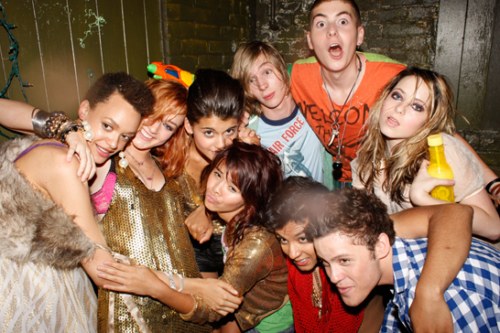
Pictured: The Biggest Threat to American Youth and Ad Sales.

There has been a lot of controversy in the last month over MTV’s Skins. The show, one of many in a long line of British television shows adapted for an American audience, very graphically depicts the hedonistic lifestyle of eight fictional high school students as they party with pills, struggle with mental illness, and sleep with each other—and, in one case, their teachers. Skins has garnered the unwanted attention of the Parents Television Council, who accuse MTV and its parent company Viacom of engaging in child pornography with its young actors. In a statement released to the press, the PTC said to Congress:
Furthermore, we urge you in the strongest possible terms to compel the Attorney General to mount an investigation by the Department of Justice into whether the production of ‘Skins’ has violated federal law meant to protect minors from exploitation.
Having the Parents Television Council on your back is dangerous in the world of television, but not because the viewing public really pays attention to their many protests of network impropriety; past outcries include a constant barrage against Gossip Girl and Family Guy, still highly successful shows despite the wagging fingers. Where the PTC can really hurt Skins, especially because it airs on a cable-only network, is with advertisers. Companies understand the threat of a backlash from angry, disposable-income-having parents, and they won’t buy ad time on a show that is being so publicly flagellated by the Parents Television Council; the groups has been attacking advertisers who run their spots during the show, criticisms bound to get back to consuming parents via action alerts (like this one) and media attention. The PTC is aware of the power it holds over spending parents, as illustrated in a menacing statement released by its President Tim Winters immediately following the first airing of Skins, in which he said: 
Every single advertiser who sponsored the premiere episode of ‘Skins’ is not only endorsing, but glorifying teen drug and alcohol abuse, not to mention a plethora of baseless sexual content. The following companies and brand names can rest assured that they will be hearing from PTC about their decision to sponsor the program: Schick Hydro, H&R Block, L’Oreal, Subway, Foot Locker, Orbit chewing gum and Extra chewing gum. We sincerely hope these advertisers will agree that the content in ‘Skins’ is harmful to their corporate image.
Since the initial airing of the pilot, seven major brands—GM, H&R Block, Proactiv, Subway, Schick, Wrigley’s, and Taco Bell—have pulled their advertisements from the Skins scheduling block. 

Now, I understand that, as a brand, you’ll do anything you can to avoid the PTC breathing down your neck or denouncing you to its constituency. I personally have no problem with the show and am a devotee of the British original, so I was a bit surprised at the massive controversy the show created amongst parents and businesses; but, once I took into account the considerable influence of the Parents Television Council, as well as the controversy the show initially caused in the UK, I understand why brands would not buy ad space during Skins. However, I am still shocked that these companies waited until after the pilot aired, after they had secured the time initially, to pull their ads. As responsible advertisers, shouldn’t they have known seen what was coming?

It’s not as if they can argue that they had no idea what risqué content their ads would be running next to. For one, before the show even hit the US airwaves the PTC was crying foul, naming it “the most dangerous television show for children that we have ever seen” Secondly, there has to be some way they could have gotten their hands on a copy of the pilot episode to screen it for content unbecoming of family-friendly businesses; if the Parents Television Council had an advance copy, I’m sure Taco Bell could have gotten one, too. Also, the show is rated TV-MA. So there were three clear signals coming in before the pilot aired that, hey, maybe Skins isn’t the show for you to place ads in if you don’t want hard-partying teens buying your products or being associated with your brand.

But even if, for some strange and incomprehensible reason, the companies couldn’t get advance warning to remove their Five Dollar Foot-long and DoubleMint ads from Skins commercial breaks, they had one obvious resource to clue them in to the content of the show: four seasons of the British original. MTV’s incarnation of Skins doesn’t stray far from the E4 version; in fact, the US pilot was essentially a shot-for-shot, line-for-line remake of its UK counterpart. The only major changes I noticed were the adjustment of slang terms that would get lost in translation in the US. In fact, the experience was a little unsettling; I heard the lines that I had so often heard on the E4 version, expecting them to come out in a British accent. It also threw me off that all the curse words were bleeped out of the show, but other than that the shows were nearly identical. American Tony Stonem manipulated his best friends, cursed at teachers, called his girlfriend “Nips,” and bough marijuana in his introductory episode just as British Tony Stonem did in Bristol. If the companies had taken the time to simply look at the source material, they would have known exactly what they were about to slap their branding on.

My personal theory is that these companies fully knew what they were getting into, but agreed to run their advertisements during the show and being aware that there were two positive outcomes: (1) the show would be wildly popular and their advertisements would reach the disposable income demographics of teens and young adults, or (2) the show would be denounced by the PTC and, once they removed their advertisements, they would be celebrated as heroic bastions of responsible business practices. Well, number 2 is exactly what happened. In the past month, for every advertiser that has pulled out of Skins, the PTC has released a statement applauding their morality. So, unsurprisingly, the businesses made the financially foolproof decision to run their advertisements regardless of the show’s content and find the positive consequence either way; its not that they have a problem with the story lines of teen promiscuity and drug use, but rather that they want the publicity that comes from being in the PTC’s good graces.

Now, this could really screw over Skins; as they lose major advertisers, it’s hard to replace them with the parental watchdog ever-looming. But at the same time, the show gains a certain amount of cache, especially among the targeted teen demographic, for being so controversial; as someone who was very recently a teenager, if my parents tried hard to shield me from something I fought even harder to see it. It boils down to the clichéd concept that all press is good press, and this kind of press will certainly draw in a curious teen audience.

However, even if MTV’s Skins can pick up a huge teen following, if it loses all its advertisers it cannot stay on the air. I really doubt the show will last past the first season, which is already in the can, so if you have been enjoying it I suggest you instead Netflix the original series. The first two seasons are so much better than the American remake, as is often the case, and you can catch early glimpses of Dev Patel (Slumdog Millionaire) and the fantastic Nicholas Hoult (up next playing the Beast in X-Men: First Class). Plus, this way you can just avoid advertisements all together.